

Dots and Boxes Strategy: The Chain Rule and Double-Cross Explained
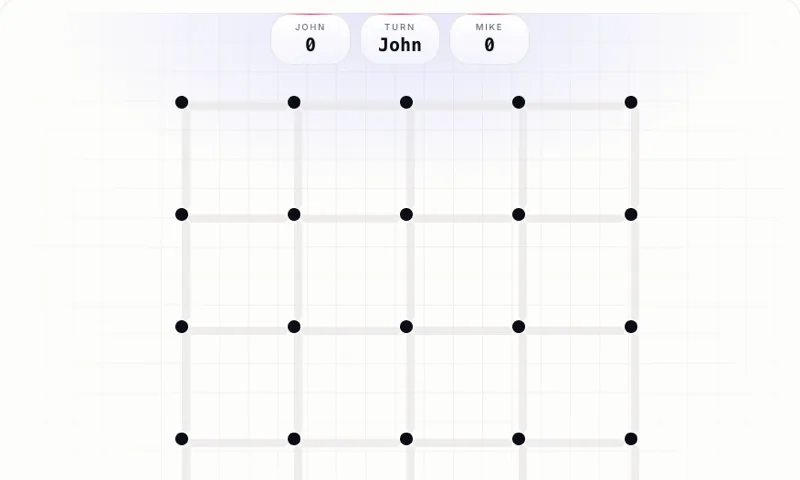
Written by the Playaby team. We build every game on this site ourselves and play through each one while writing its guide, so the tips above come from actually testing the mechanics — not generic advice.
Dots and Boxes reads as the simplest game on the site: connect two dots, and if you complete the fourth side of a box, it's yours. What that simple rule hides is a real endgame theory that mathematicians have picked apart since the 19th century, and the gap between a player who knows it and one who doesn't is enormous — the double-cross alone will win you games you have no business winning.
Chains, the double-cross, and the one rule that protects both
The single rule that matters most early on: never draw a line that gives a box three completed sides. That fourth side is a free gift to whoever moves next — they take the box and move again immediately. Most early losses in Dots and Boxes come from not seeing that a 'safe-looking' line quietly hands over a box a move or two later, not from any single obvious blunder.
As the board fills up, boxes stop being isolated and start linking into chains — runs of boxes where completing one forces the next one open too. Once only chains are left on the board, the player forced to open a chain first is usually in trouble, because their opponent can often take the entire chain in one uninterrupted turn. This is where the real game happens, and it's also where the double-cross comes in.
Here is the move that separates strong players from everyone else. When you're taking a long chain, do not take every single box in it. Stop two boxes short, and instead of completing one of them, draw the line that leaves both of those last two boxes for your opponent. They're forced to take those two free boxes, but taking them means they now have to open the next chain themselves — handing the much bigger chain straight back to you. It feels wrong to hand your opponent two free boxes, which is exactly why so many players never learn this move, but two sacrificed boxes is a small price if it forces your opponent to open the next chain, especially late in the game when chains tend to get longer. Counting ahead — how many chains are left, and roughly how long each one is — tells you whether a double-cross is worth it or whether you should just take the whole chain and accept opening the next one yourself.
| Board size | How much the chain rule matters |
|---|---|
| 3×3 | Barely comes up — no room for long chains to form |
| 6×6 | Chain control becomes most of the game |
| 8×8 | Same as 6×6, more so — a player who ignores chains keeps losing to one who counts them |
Do I need to master the double-cross to beat the CPU?
Not really on the smaller boards — the CPU here plays a simple, honest heuristic: take a free box if one's available, otherwise play any line that doesn't hand you a free box, and only concede one at random if it has no other legal move. It's not secretly counting chains against you. On bigger boards that same simple CPU still opens long chains the moment it runs out of safe moves, so a player who understands the double-cross will start winning those chains cleanly even though the CPU's logic never changed.
What about short chains — is the double-cross ever a bad idea?
Yes, and this is where counting ahead actually pays off. Sacrificing two boxes only makes sense if the chain you're handing back control of, the one your opponent has to open next, is worth more than two boxes to you. On a chain of exactly two or three boxes, giving up two just to force your opponent into opening a chain of similar size is close to a wash, and sometimes a straight loss if it's the very last chain on the board with nothing left to win back. The double-cross earns its keep on long chains late in the game, not short ones, so it's worth doing a rough count of remaining chain lengths before committing to the sacrifice rather than applying it as a fixed rule every time.
Try counting chains out loud on your next game, even just roughly. The moment you can tell your opponent is one move away from forcing you to open a long chain is the moment Dots and Boxes stops looking like a doodle and starts looking like the endgame puzzle it actually is — and if you'd rather test that against a real opponent, you can create a room and send a friend the code or link so they join from their own device, same rules and same chain-and-double-cross endgame, just played against a person instead of the CPU.