

Devil Trap: Tips for Surviving Every Trap in 40 Levels
Written by the Playaby team. We build every game on this site ourselves and play through each one while writing its guide, so the tips above come from actually testing the mechanics — not generic advice.
Devil Trap isn't out to be fair. It's out to be funny — every hazard in its 40 levels exists to punish a reasonable assumption, like the idea that a platform is solid, a flag is safe, or the floor is still where it was a second ago. Once you stop assuming and start testing, the game stops feeling unfair and starts feeling readable.
The one rule
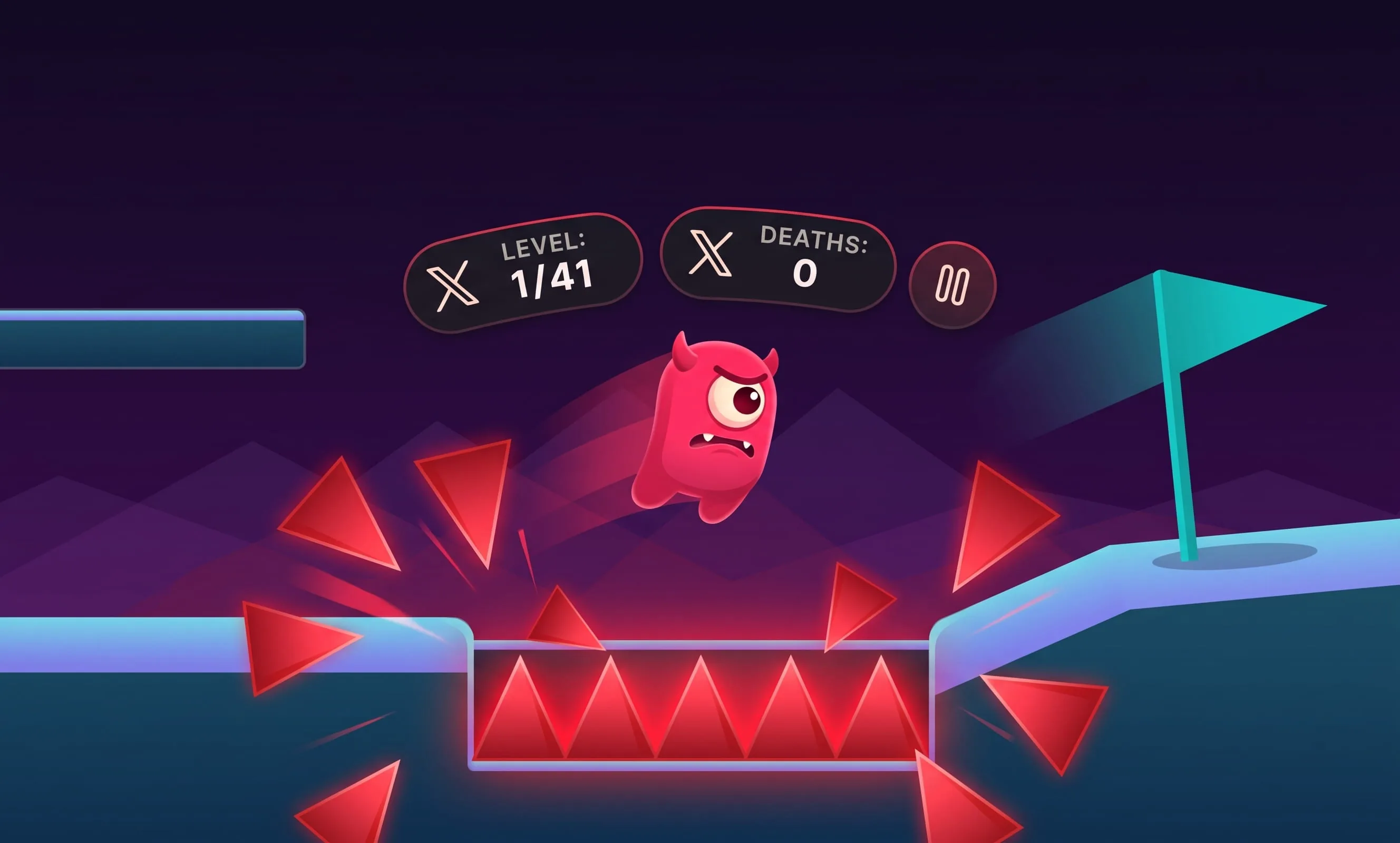
Devil Trap punishes assumptions, not reflexes — slow down and it stops being cruel.
The four habits that actually work
Test tiles before you trust them
Cracked-looking tiles aren't always the ones that break, and perfectly normal-looking tiles sometimes are. A small hop onto a tile before committing your full run buys you just enough time to react if it gives way.
Watch for delayed ambushes
Some of the later levels arm a trap the moment you enter an area, then fire it a beat later. If a section feels suspiciously easy, that's the tell — slow down instead of sprinting through it.
Read fake flags correctly
A flag that isn't the real finish flashes a message once and lets you pass straight through. It won't push you back or trap you, so if you see the fake-out message, just keep moving and look for the real flag nearby.
Treat death as free information
There's no lives counter and no penalty beyond respawning at the start of the level. Every death just tells you where the next trap is, which makes level 40 a lot less intimidating than your first attempt suggests.
Learn to spot the two traps that fool everyone at least once
The disguised solid tile
Once you've been burned by a few crumbling floors, the instinct is to treat every cracked-looking tile as a threat and hesitate before stepping on anything that doesn't look pristine. Devil Trap knows this and plants a handful of tiles specifically designed to look exactly like a crumbling floor while actually being completely solid — placed to punish the exact caution the earlier levels taught you. There's no reliable visual tell that separates a real crack from a fake one on first glance, so the small test-hop habit matters here too: a quick tap tells you the truth before your full-speed run commits to a tile that either holds or doesn't.
Fake flags near the real exit
Later levels place a flag that looks identical to the real finish line somewhere along the path, and touching it does nothing dramatic — no trap springs, no fall, just a flash of text and a moment where you keep moving forward. That's actually the tell. A fake flag never punishes you for touching it, so the moment you see that message, don't backtrack looking for a trick you triggered. The real flag is always somewhere nearby, and the fake one exists purely to make you second-guess whether you've already finished.
Later stages add a few more wrinkles on top of the basics: rocks dropping from off-screen at randomized intervals that never repeat the same timing twice, and a fog effect that shrinks your visible radius down to a small circle around your character. Neither one changes the core rule. Slow down, test what you're not sure about, and treat every death as a note for next time rather than a reason to get frustrated.
Why the levels are all hand-built instead of randomly generated
All 40 levels are hand-authored rather than procedurally generated, which matters more than it might seem for a game built around punishing assumptions. A randomly generated trap layout can accidentally be unfair in a way that feels arbitrary rather than clever — a floor that breaks with genuinely no way to react in time isn't a puzzle, it's just bad luck. Hand-building every level means every trap was placed with a specific assumption in mind that it's meant to punish, and every trap has at least one honest tell if you're paying attention, even if that tell is subtle. That's also why no two levels repeat the same hazard combination twice: repeating a trick would mean a returning player could solve it from memory rather than from actually reading the level, which defeats the entire point of the design.
The full level map is unlocked from the start too, rather than gating you level by level. That's a deliberate choice as much as the trap design is — if you want to skip straight to level 40 out of curiosity, or jump back to an earlier level to practice a specific trick you keep missing, nothing stands in the way. Progress isn't the point; learning to read the room is.
Nothing in Devil Trap actually costs you anything but time — so the only real mistake is not paying attention.