

Bounce Trouble: Tips for Surviving All 50 Stages
Written by the Playaby team. We build every game on this site ourselves and play through each one while writing its guide, so the tips above come from actually testing the mechanics — not generic advice.
Bounce Trouble looks like a standard platformer from the world map, then immediately removes the one control everyone expects: there is no jump button. Your ball bounces the instant it lands on a platform, whether or not that platform is trustworthy, and the only real decisions left are which way to drift in the air and when to spend your dash. That's the whole game across 50 stages split into 10 worlds of 5 stages each, with every fifth stage marked as a boss stage closing out its world.
- Stop thinking of "JUMP" as a jump. Press Space, Shift, Up, W, or tap the on-screen button and your ball punches sideways in whatever direction you're holding (or your current direction of travel if you're holding neither), with a small vertical kick thrown in — then locks out for a bit over two seconds while a DEVIL DASH! popup fades and the indicator reads RECHARGING. Use it as a horizontal burst for closing gaps or bailing out of a bad landing, never as a way to gain height on command.
- Don't trust a platform you haven't landed on before. Solid ground is the minority once a stage gets going — crumbling platforms hold your bounce for a fraction of a second before breaking away, fake ones look identical but let you fall straight through with no landing at all, and moving ones drift back and forth on a rhythm you have to time. There's no visual tell that separates a fake platform from a real one on first sight, so keep enough spare momentum to bail toward a platform you already know is safe.
- Push onto genuinely new ground to move your checkpoint. You get 3 lives per stage, and dying sends you back to your last checkpoint rather than the start — which matters a lot over 50 stages. But a checkpoint only updates once you land on solid, non-crumbling ground meaningfully further along than your previous best. Bouncing back over ground you've already covered, or landing on something crumbling, banks nothing.
- Memorize hidden tricks instead of panicking at them. Certain points in a stage are wired to a one-off surprise the first time you cross them — reversed controls for a few seconds, spikes erupting from clear floor, a nearby platform dropping out, a launch pad firing you skyward, or a wall suddenly blocking the path. Each one announces itself with an on-screen banner the instant it triggers, and none of them fire twice in the same run, so a death right after a trick almost always means that exact trick won't catch you again next attempt.
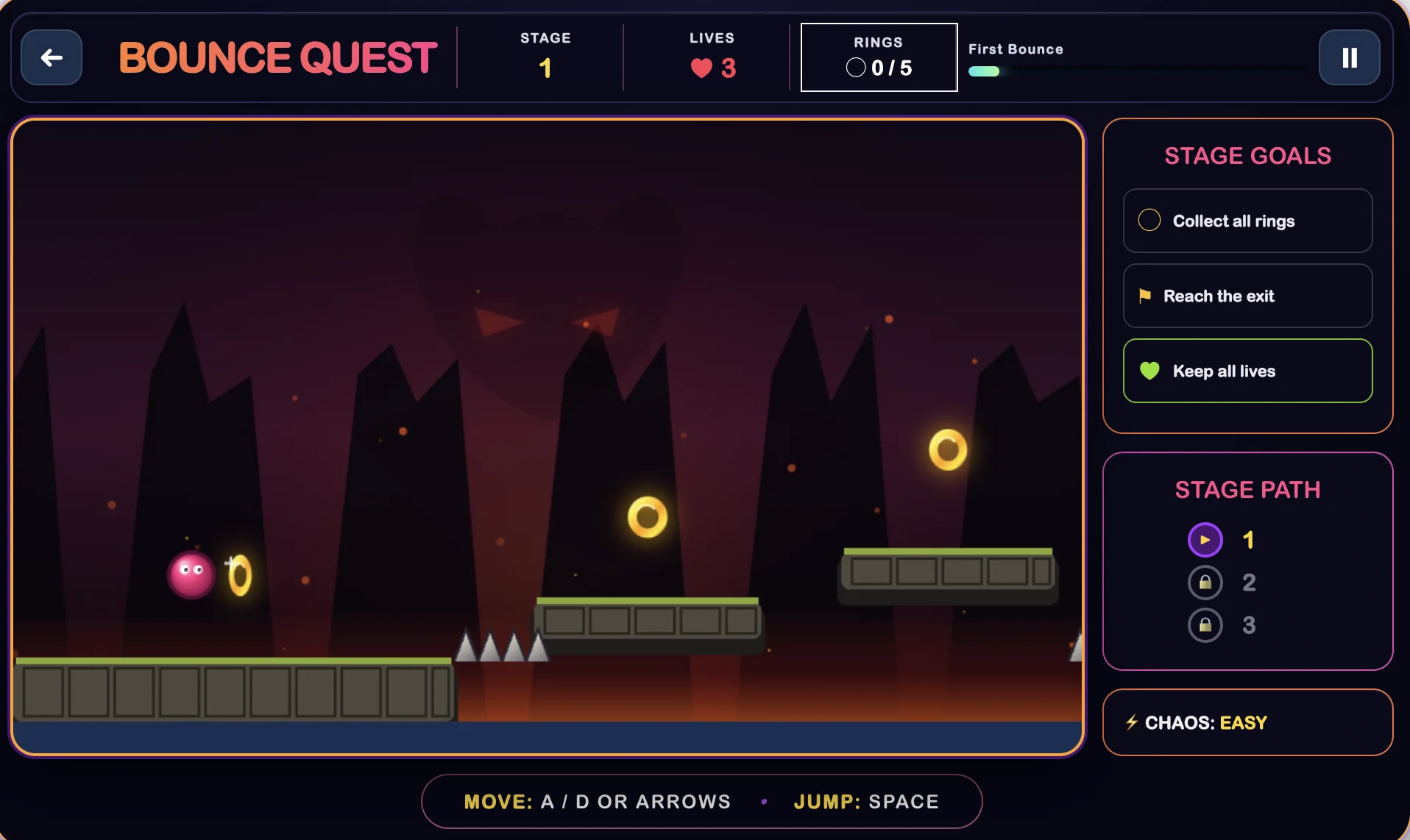
The sidebar's Chaos rating isn't flavor text reacting to how you're playing — it's a direct readout of the stage number, full stop. Here's what each band actually means for the platforms under your feet:
| Stages | Chaos label | What changes |
|---|---|---|
| 1–10 | Easy | baseline mix of platforms |
| 11–30 | Medium | more crumbling/fake platforms, faster moving ones |
| 31–50 | Devil | even more of the same, at its hardest |
Does Bounce Trouble have an actual jump button?
No — your ball bounces automatically off anything solid it lands on. What the game calls the JUMP button is really a short dash on a roughly two-second cooldown, and it's the only input besides steering left and right in the air.
How the checkpoint system actually decides where you respawn
It's worth understanding exactly what counts as progress, since misreading it is one of the more common sources of frustration on the later worlds. A checkpoint only banks once you land on solid, non-crumbling ground that's meaningfully further along the stage than your previous furthest point — bouncing backward over ground you've already cleared, landing on a crumbling platform that then gives way, or drifting sideways without net forward progress all bank nothing, even if the bounce itself felt successful in the moment. That's deliberately stricter than a simple distance-traveled counter, because it means a checkpoint only ever represents ground you've proven is actually safe, not just ground you happened to pass over once.
None of the 50 stages ask for anything beyond steering and one well-timed dash — the real challenge is reading what a platform is about to do before you commit to it. Head into Bounce Trouble and see how far the Chaos rating climbs before it catches you.