

Blackjack Basic Strategy for Casual Players: When to Hit, Stand, and Walk Away
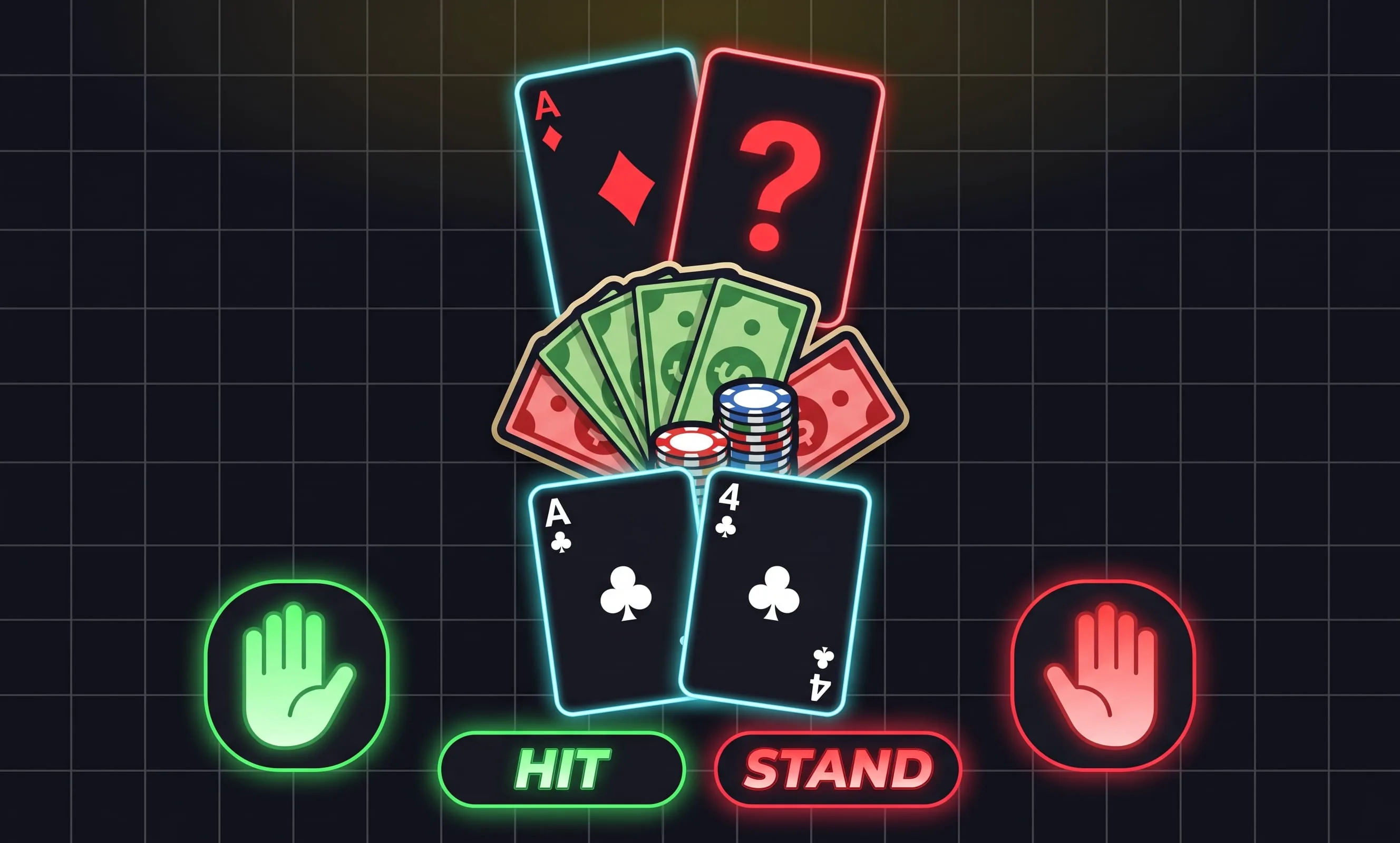
Written by the Playaby team. We build every game on this site ourselves and play through each one while writing its guide, so the tips above come from actually testing the mechanics — not generic advice.
Blackjack has a reputation for being pure luck, but the hit-or-stand decision is one of the more mathematically well studied choices in any card game. The single biggest mistake casual players make is deciding whether to hit based only on their own hand. Your decision should almost always be based on what the dealer is showing. A dealer showing a 6 is in a weak position and likely to bust, so you can afford to play conservatively. A dealer showing a 9, 10, or an ace is in a strong position, and you need to take more risks with your own hand to keep up. Here's the whole chart, condensed.
| Your total | Dealer shows 4, 5, or 6 (weak) | Dealer shows 9, 10, or ace (strong) |
|---|---|---|
| 11 or less | Hit | Hit |
| 12–16 (hard) | Stand | Hit |
| 17+ (hard) | Stand | Stand |
| Soft 17 (A+6) | Hit | Hit |
Two terms in that table do a lot of work. A 'hard' hand has no ace flexible enough to save you, so a hard 16 is one bad card away from busting with no safety net — which is exactly why hard 12 through 16 is where most of the actual decision making happens, and where the dealer's upcard flips the right answer. A 'soft' hand has an ace still counting as 11, like an ace and a 6 making a soft 17, and because that ace can drop to a 1 if the next card would otherwise bust you, soft hands are much safer to hit than the same total without an ace — a soft 17 is worth hitting in most situations even though a hard 17 is a clear stand.
Two quick notes on the version here: it keeps things simple, with the dealer drawing automatically until reaching 17 and no doubling down or splitting pairs, which makes it a solid way to drill the core hit-or-stand instinct before that logic carries over to a version with more options. And no, basic strategy isn't card counting — basic strategy is this fixed table of best-odds decisions that never changes from round to round, while card counting separately tracks which cards have already been played to estimate what's left in the deck. Basic strategy alone, applied consistently, is what closes most of the gap between a casual player and an experienced one.
Why the dealer's upcard changes everything
It's worth sitting with why the dealer's upcard matters this much, because it's the part most casual players skip past. The dealer has to hit until reaching 17, with no choice in the matter — no standing early on a bad hand, no bailing out of a bust. That fixed rule means a dealer showing a low card, like a 4, 5, or 6, is genuinely likely to draw itself into a bust before it ever reaches 17, because there's a wide range of cards that would push a hand starting that low over 21 before the dealer is allowed to stop. Your best move in that spot is often to do nothing and let the dealer's own forced rules beat them. Stand on a stiff hand like 12 through 16 against a dealer showing a 6, resist the urge to hit just because your own total feels shaky, and let the math play out.
The flip side is just as important. A dealer showing a 9, 10, or an ace is already sitting close to a strong hand with no real risk of busting on the next card alone, so standing on a mediocre total in that spot is close to giving up. That's when hitting a hard 12 through 16 actually makes sense even though it feels riskier — the alternative, standing on 15 against a dealer who's very likely already at 19 or 20, loses more often than the small bust risk from hitting does.
None of this guarantees a win on any single hand. Blackjack still has a house edge and a healthy dose of chance built into every shuffle. What basic strategy actually does is stop you from making the same costly mistakes over and over, so the hands you do win aren't being cancelled out by decisions you already knew were wrong.