

How to Beat the Connect 4 CPU: Exploiting a One-Move-Ahead AI
由Playaby团队撰写。 网站上的每一款游戏都由我们亲自开发,撰写攻略时也会亲自把每款游戏玩一遍,所以上面的这些技巧都来自对游戏机制的实际测试——而不是泛泛而谈的建议。
Every CPU opponent you'll face in this build of Connect 4 runs the exact same three-step logic on every single turn, with no difficulty setting and no randomness hiding underneath it. Once you know what those three steps are, you can build a trap the CPU is structurally incapable of seeing coming — not because it gets unlucky, but because its own rules never let it look far enough ahead to notice.
How the CPU actually decides its move
- Check every column for an immediate win. If dropping a disc anywhere completes four in a row right now, it takes that column without hesitation — it never misses a free win sitting on the board.
- If no winning move exists, check every column for a move that blocks your immediate win. Leave three in a row open on your turn and the CPU will shut it down.
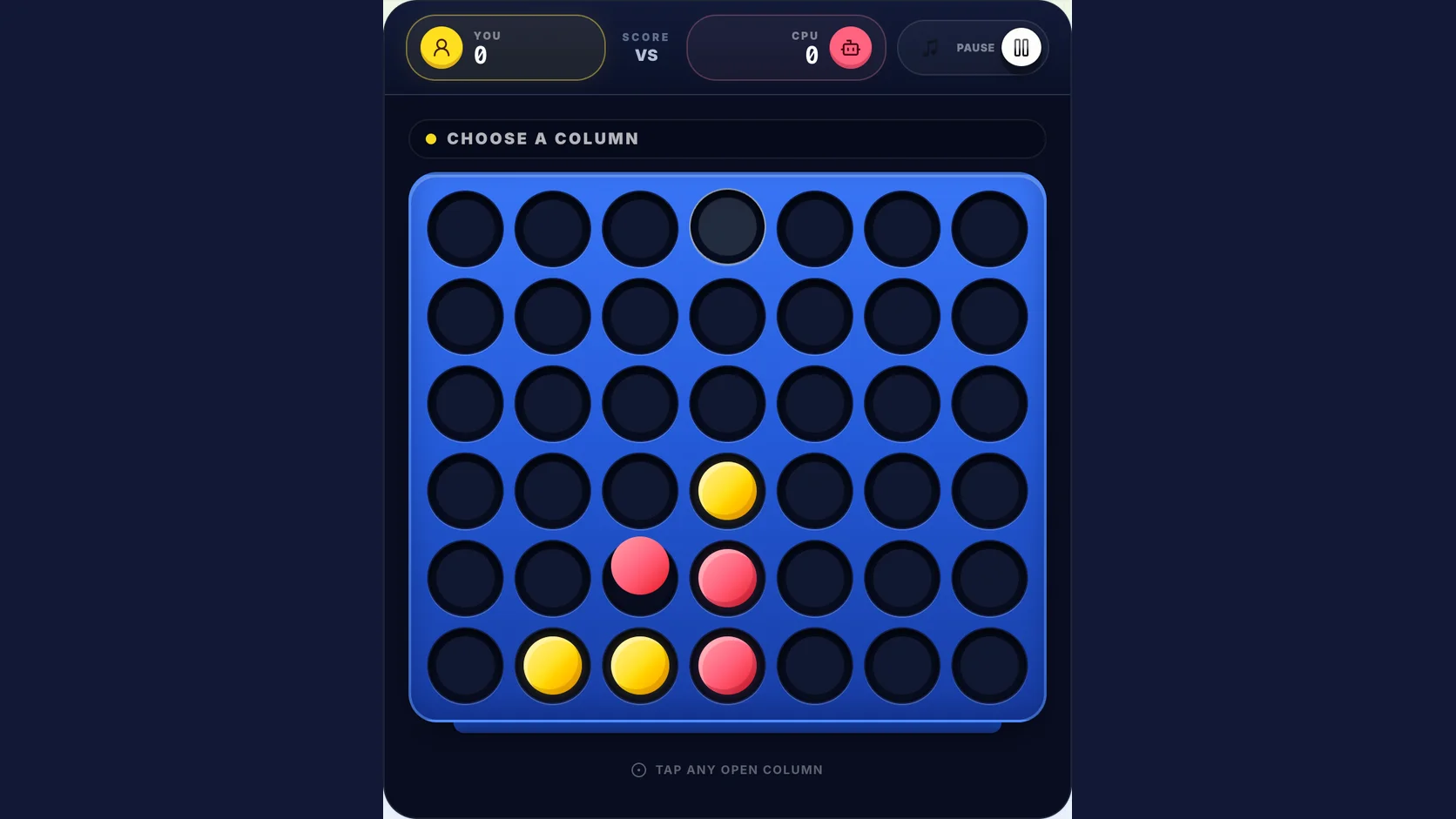
- If neither a win nor a block applies, it falls back to a fixed, unchanging preference order: column 4 first, then 3, 5, 2, 6, 1, and finally 7 — the real game's known center-column bias, hardcoded rather than calculated.
That's the entire decision tree. There's a fixed 450 millisecond pause before each drop so the move doesn't feel instant, but that's pacing, not thinking — the CPU already knows its move before the pause even starts. Critically, all three steps only ever evaluate the board as it exists on the current turn. It never simulates what the board would look like two or three moves from now, which means it has no concept of a threat that doesn't already exist yet.
The exploit: force a double threat
A double threat is a position where two different columns would each complete a four-in-a-row on your next turn. Because the CPU's block check only fires against a win that already exists on the board right now, it can only ever see and block one threat per turn — even when a second, equally real one is sitting right next to it. Give it two winning moves to choose from in the same turn and it mathematically cannot block both, no matter how the pause or the fallback order plays out.
- Build two separate three-in-a-row lines that would each complete on a different column, timed so both become 'live' on the same turn.
- A common shape is two horizontal or diagonal lines sharing one disc, or two stacked threats in neighboring columns rather than one — spread the danger, not the height.
- Avoid completing either line early. If you finish one three-in-a-row before the second is ready, the CPU's block step catches it immediately since only one threat exists at that point.
- Once both are simultaneously one move from winning, play any move that doesn't hand the CPU an immediate win of its own, then take whichever of your two threats it fails to block on its next turn.
Why the 450ms pause is a red herring
It's tempting to read meaning into the CPU's short pause before every drop, as if a longer one means it's struggling with a harder position. It isn't — the delay is a fixed 450 milliseconds regardless of what's on the board, purely for pacing so the CPU's move never feels instant. The actual decision is made instantly; the pause is cosmetic.
Can the CPU ever see a double threat coming?
No. Its win check and block check both evaluate only the board as it stands on the current turn — it has no lookahead beyond that single step, so a threat that doesn't yet exist is invisible to it by design, not by accident. That also means a double threat isn't a fluke or an exploit of a bug; it's the direct, predictable consequence of how far the logic is built to look. Set one up correctly and the CPU cannot adapt around it, no matter how many rounds you replay.
Combine this with the center-column opening advantage — column 4 first, always — and you're playing a version of Connect 4 the CPU is fundamentally not equipped to answer. It'll still take every free win and block every single threat you leave lying around one at a time. Give it two at once, and that's the game.